

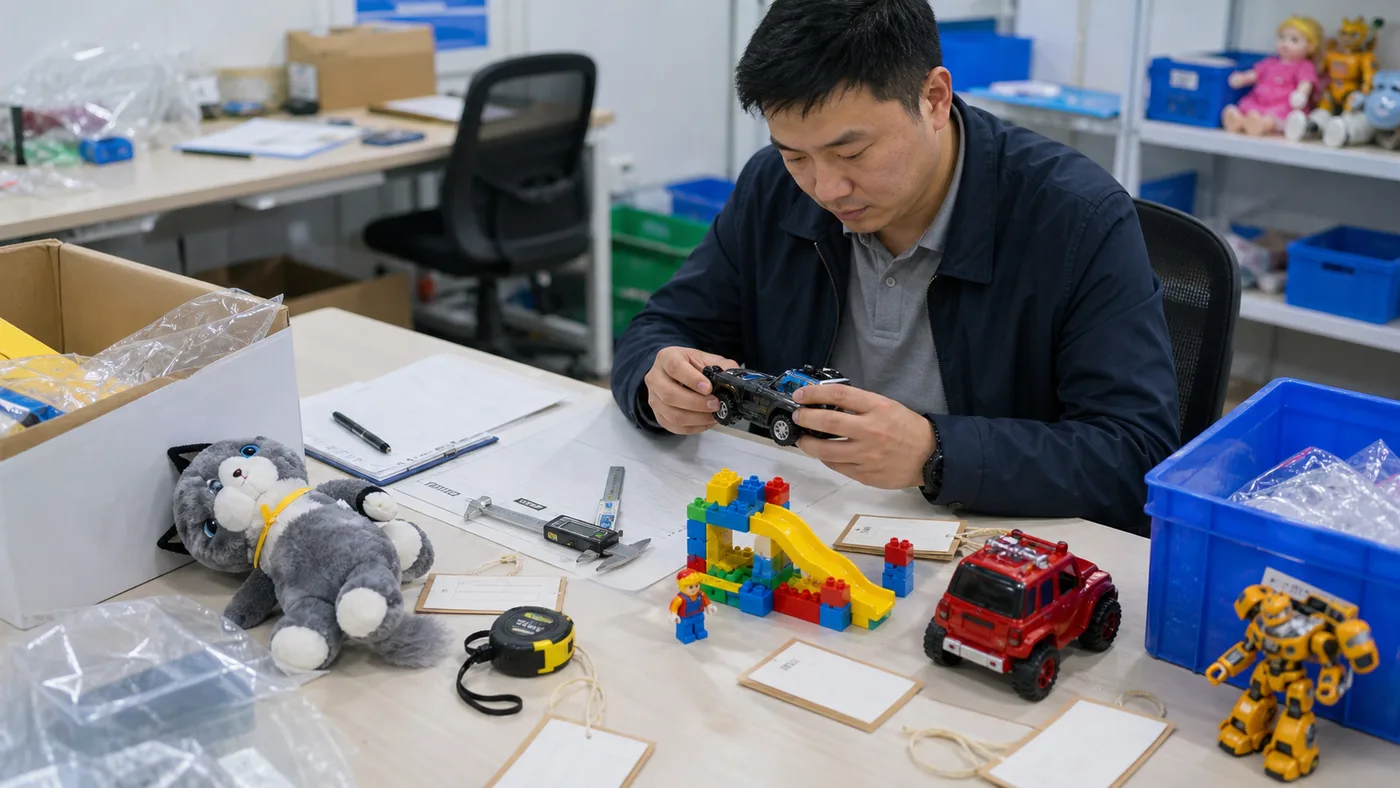



When a toy supplier says, “We have CE,” an importer still does not have enough information to approve an order.
The CE mark is not a universal certificate. An EN 71 report does not automatically satisfy US requirements. A test report for a similar-looking model may not cover the materials, components, age grade, or packaging used in your order.
The practical question is therefore not simply, “Does the supplier have a certificate?” It is:
Do the available documents match this product, this production specification, and the market where it will be sold?
This guide explains the main toy compliance documents importers may encounter in the European Union and the United States. It also explains how to review a supplier’s test report and when an existing report may no longer be sufficient.
Compliance requirements depend on the product and destination market. Treat this article as a purchasing and document-review guide, not legal advice. Confirm the final testing plan with a qualified compliance professional or appropriately accredited laboratory.
Not sure which documents your toy order needs?
Define the destination market, age grade, matériels, functions, and packaging before requesting reports.
Contact LuluFamily to organize your document checklist
Why “We Have CE” Is Not Enough
Buyers often ask suppliers for a “CE certificate” because it sounds like one simple document that proves a toy is ready for Europe. In practice, EU conformity involves more than placing a CE logo on the product or sending the first page of a laboratory report.
For toys placed on the EU market, the manufacturer is responsible for completing the applicable conformity assessment, preparing technical documentation, issuing the EU Declaration of Conformity, and affixing the CE marking.
Depending on the product and conformity-assessment route, laboratory reports may form part of the supporting evidence. Cependant, a CE logo by itself does not answer important purchasing questions:
- Which exact model was assessed?
- Which materials and components were tested?
- Which parts of the EN 71 series were applied?
- Does the report cover the intended age group?
- Do the warnings and packaging match the assessed product?
- Has any material, component, usine, or design changed since testing?
The same principle applies in the United States. A supplier may send an ASTM F963 report, but the importer still needs to determine whether the report covers the ordered product and supports the required Children’s Product Certificate.
The purpose of document review is not to collect the largest possible folder of PDFs. It is to build a traceable connection between the tested sample, the production specification, the bulk order, and the legal requirements of the destination market.
EN 71, ASTM F963, CPSIA, and CE Explained
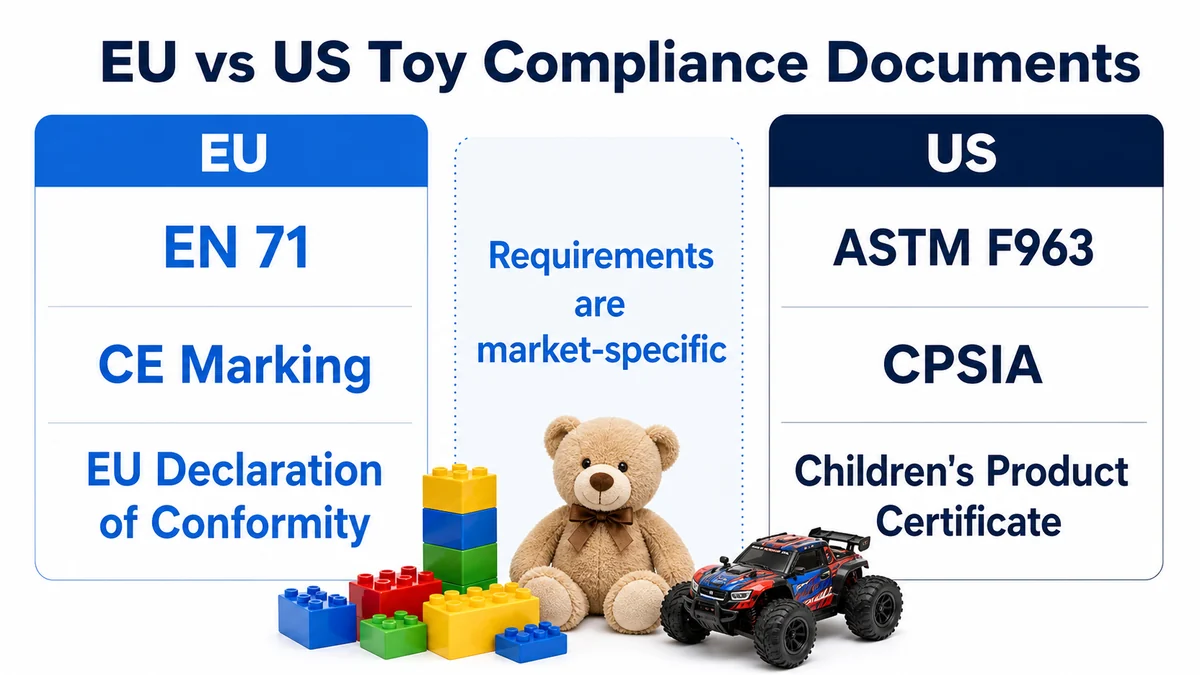
These terms are often grouped together in supplier conversations, but they do not represent four equivalent certificates.
| Term | Main market | What it is | What the buyer should review |
|---|---|---|---|
| EN 71 | European Union and markets referencing it | A series of toy safety standards | Applicable report sections, product details, résultats, and standard editions |
| CE marking | European Economic Area | A manufacturer’s indication of conformity with applicable EU requirements | Declaration of Conformity, technical documentation, labeling, and traceability |
| ASTM F963 | États-Unis | The mandatory US toy safety standard | Applicable sections, product details, laboratory information, and results |
| CPSIA | États-Unis | A law covering several children’s-product safety requirements | Lead, phthalate, testing, attestation, and tracking requirements |
| CPC | États-Unis | A written Children’s Product Certificate | Product identity, applicable rules, test information, laboratory details, and responsible party |
An EN 71 test report is evidence related to specific tests. It is not the same as an EU Declaration of Conformity, and it does not transfer responsibility from the manufacturer or importer to the laboratory.
De la même manière, CPSIA is not one laboratory test. It is legislation containing several obligations. The applicable requirements depend on the product, its materials, intended users, and foreseeable use.
Not every section of ASTM F963 applies to every toy. Some products may also be subject to requirements outside ASTM F963, including lead limits, phthalate limits, small-parts restrictions, tracking labels, or product-specific regulations.
Documents to Request for the EU Market
The exact document package depends on the toy. Cependant, an importer reviewing an EU order will commonly need to confirm the following documents and information.
Product-Specific Test Reports
Request reports that identify the actual toy and cover the applicable requirements.
EN 71-1, EN 71-2, and EN 71-3 are commonly discussed, but additional standards or legislation may apply depending on the product.
Par exemple, electronic or radio-controlled toys may involve electrical, electromagnetic compatibility, radio-equipment, chemical, battery, or environmental requirements.
Do not create the testing list by copying a report from an unrelated product. Start with the actual design, matériels, functions, age grade, power source, and destination market.
EU Declaration of Conformity
The Declaration of Conformity is a formal manufacturer document. It should identify the toy, manufacturer, applicable legislation and standards, and the person authorized to sign for the manufacturer.
Check that the declaration refers to the product you are purchasing. A generic declaration covering “plastic toys” without a usable model number provides weak traceability.
Technical Documentation
The technical file may include:
- Product description and design information
- Relevant material specifications
- Safety assessment
- Manufacturing and quality-control information
- Test reports and calculations
- Labels, warnings, and instructions
- EU Declaration of Conformity
An importer may not receive every internal factory document during the quotation stage. Cependant, the responsible parties should be able to demonstrate that the required documentation exists and corresponds to the product.
CE Marking and Traceability
Review the CE marking together with:
- Manufacturer name and contact address
- Importer details where required
- Model, batch or serial identification
- Age grading and warnings
- Instructions in the required language
The EU has also adopted a new toy-safety framework under Regulation (UE) 2025/2509, including a digital product passport. Importers should monitor its transition and implementation requirements rather than assuming that every supplier must provide the new system immediately.
Documents to Request for the US Market
For toys intended for the United States, importers should build the document package around the applicable federal requirements rather than asking only for “an ASTM report.”
Applicable ASTM F963 Test Results
The report should show which ASTM F963 sections were considered and tested. Because the standard covers many types of hazards and toys, the applicable sections vary by product.
Check whether testing that requires a third-party laboratory was performed by a CPSC-accepted laboratory. The laboratory’s acceptance must cover the relevant test scope.
A laboratory name alone does not prove that every test listed in a report falls within its accepted scope.
CPSIA-Related Testing
Depending on the product and materials, testing may include:
- Total lead in accessible components
- Lead in paint or surface coatings
- Regulated phthalates in accessible plasticized materials
- Other applicable children’s-product requirements
A statement saying “CPSIA compliant” is not a substitute for determining which rules apply and reviewing the supporting test results.
Certificat de produit pour enfants
Children’s products subject to applicable safety rules require a written CPC supported by passing test results where third-party testing is required.
The CPC should identify the product, list the applicable safety rules, provide the responsible manufacturer or importer’s information, identify where and when the product was manufactured and tested, and identify the laboratory involved.
The CPC is generally issued by the manufacturer or importer responsible under US law. It is not simply a certificate purchased from a laboratory.
Tracking Labels and Warnings
Review the product and packaging for required tracking information. Depending on the product, this may include information identifying:
- Manufacturer
- Production location
- Production date
- Batch or production run
Also check age grading, choking-hazard warnings, instructions, and online advertising warnings where applicable.
A passing chemical report does not correct missing or inaccurate labeling.
How to Verify a Supplier’s Test Report

Match the Product Identity
Compare the report’s product name, model number, photos, dimensions, couleurs, and functions with the quotation, approved sample, packaging artwork, and purchase order.
Do not accept “same series” without understanding the differences. A change that looks cosmetic may introduce a different coating, plastique, battery, magnet, small part, or mechanical hazard.
Match the Age Grade
The intended age affects foreseeable use, labeling, small-parts considerations, and applicable tests.
The age grade in the report should not conflict with the product design, conditionnement, advertising, or sales listing.
Match the Materials and Components
Pay particular attention to:
- Paints, inks and coatings
- Soft plastic and rubber parts
- Batteries and charging components
- Magnets
- Electronic and radio components
- Cordons, straps and projectiles
- Stuffing, fabrics and accessories
Ask for enough specification information to connect the tested sample with the materials intended for production.
Check the Standards and Editions
Confirm that the report identifies the standards and versions used. Check whether they are suitable for the product and planned market-placement date.
Do not rely on the supplier’s filename. Read the report scope and conclusion.
Review the Complete Report
The cover page is not enough. Revoir:
- Sample description
- Sample receipt and test dates
- Test methods
- Results and observations
- Product photos
- Deviations and exclusions
- Subcontracted tests
- Authorization information
Watch for pages that appear to come from different reports or photos that do not match the ordered product.
Verify the Applicant, Factory, and Laboratory
Understand the relationship between the report applicant, the factory producing the order, and the supplier named in the quotation.
If the report belongs to another company, ask why the current supplier is authorized to use it and how the tested product is connected to your order.
Where possible, verify the report number with the issuing laboratory. For US children’s products, confirm that the laboratory is CPSC-accepted for the relevant scope.
Have a supplier report but cannot confirm whether it covers your order?
Compare the report with the product sample, packaging artwork, matériels, and purchase specification before approving production.
Ask LuluFamily to help organize the review points
When Existing Reports Are Not Enough
An existing report should be reassessed whenever a change could affect compliance.
Common triggers include:
- A new paint, ink, coating, plastic resin, fabric, or stuffing material
- A different battery, charger, moteur, circuit board, magnet, or radio module
- A change in component supplier
- A new factory or production process
- Modified dimensions, structure, vitesse, son, or projectile force
- Addition or removal of small parts, cords, straps, or magnets
- A different intended age group
- New packaging, warnings, or instructions
- Entry into a new destination market
For US children’s products, a material change may require retesting of the affected product or component and a new CPC based on passing results.
Whether component testing is enough depends on whether the change can affect other requirements or the finished product’s compliance.
Par exemple, changing a paint supplier may primarily affect chemical testing of the coating. Changing a structural part, battery system, or mechanical design may require a broader finished-product assessment.
A practical change-control process should include:
- The supplier identifies the proposed change.
- The buyer assesses the affected requirements.
- Required samples or components are tested.
- Reports and certificates are updated.
- Production continues only after written approval.
Common Compliance Document Red Flags
Pause the order and investigate further if:
- The supplier provides only a CE logo or one-page “certificate.”
- The report model does not match the quotation or packaging.
- The report shows different colors, matériels, or components.
- The supplier sends only the first page of the report.
- The report applicant has no clear relationship with the factory.
- An EU report is presented as proof of US compliance, or vice versa.
- One report is used for many products without a clear grouping method.
- The laboratory or report number cannot be verified.
- The report predates significant product or material changes.
- Warnings and instructions are treated as an afterthought.
A report can be genuine and still be unsuitable for your order. Authenticity is only one part of the review. Product coverage is equally important.
Pre-Order Compliance Document Checklist
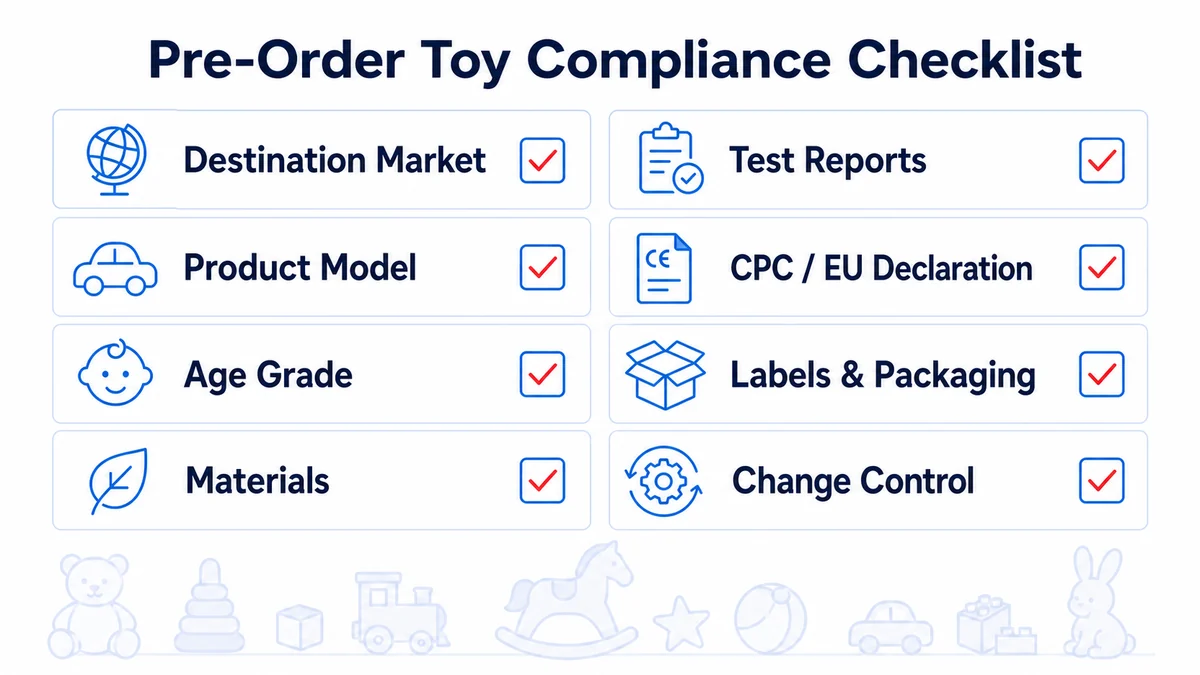
Use this checklist before paying a deposit or approving bulk production.
| Checkpoint | Questions to Confirm |
|---|---|
| Destination market | Where will the toy be imported and sold? |
| Product classification | Is it a toy, children’s product, electronic toy, or radio product? |
| Intended age | Is the age grade consistent with the design, conditionnement, and advertising? |
| Product identity | Do the model, SKU, photos, dimensions, functions, and colors match? |
| Materials | Can production materials be connected to the tested sample? |
| Applicable requirements | Has a product-specific testing plan been prepared? |
| Laboratory | Is the laboratory accepted or accredited for the required scope? |
| Full reports | Are the complete reports available, including photos and results? |
| EU documents | Are the Declaration of Conformity, CE marking, and traceability information aligned? |
| US documents | Are the test results sufficient to support a correctly completed CPC? |
| Conditionnement | Are warnings, instructions, age grading, and tracking information correct? |
| Change control | Must the supplier obtain approval before making changes? |
| Production inspection | Will bulk goods be checked against the approved sample? |
| Record retention | Who will keep the final reports and production records? |
Do not mark the checklist complete merely because every row has an attachment. The documents must agree with one another.
Par exemple, the report may show age 8+, the packaging may show age 3+, and the online listing may describe the toy as suitable for toddlers. That is not simply a paperwork problem. It is a safety and product-positioning problem that must be resolved before sale.
Build Compliance Into the Purchase Order
Compliance becomes easier to manage when it is written into the commercial order instead of discussed only in chat messages.
Consider including:
- Destination market and applicable requirements
- Approved product model, matériels, couleurs, and components
- Approved age grade
- Approved packaging artwork and warning text
- Written approval before any substitution
- Responsibility for agreed testing costs
- Delivery dates for reports and samples
- Procedures for failed tests
- Rights to inspect bulk production
- Responsibility for unauthorized changes
Connect the compliance package to the sample-approval process. The approved sample should represent the materials and construction intended for production.
You can use the toy samples checklist before bulk production to review the sample before approving mass production.
When comparing suppliers, also check the testing and documentation assumptions behind each quotation. A lower unit price may exclude testing, compliant packaging, labeling work, or material controls.
The guide to comparing toy quotations from Chinese suppliers explains how to compare quotations beyond the headline price.
Packaging should also be reviewed before production. See the toy packaging guide for importers for packaging specifications and approval points.
Final Takeaway
A supplier’s document folder is only the starting point.
Before approving a toy order, confirm that:
- The destination market and age grade are defined.
- The applicable requirements have been identified.
- Reports match the ordered model, matériels, components, and functions.
- The laboratory and report can be verified.
- EU or US declarations and certificates are prepared by the responsible party.
- Conditionnement, warnings, and traceability information match the product.
- Materials and designs cannot be changed without review.
The most expensive time to discover a compliance gap is after production, final payment, or customs arrival.
Build document review into supplier selection, sample approval, packaging confirmation, and the purchase order.
Preparing a toy order for the EU or US market? LuluFamily can help organize the product specification, supplier documents, packaging information, and questions that should be clarified before production.